-
How Can You Help?
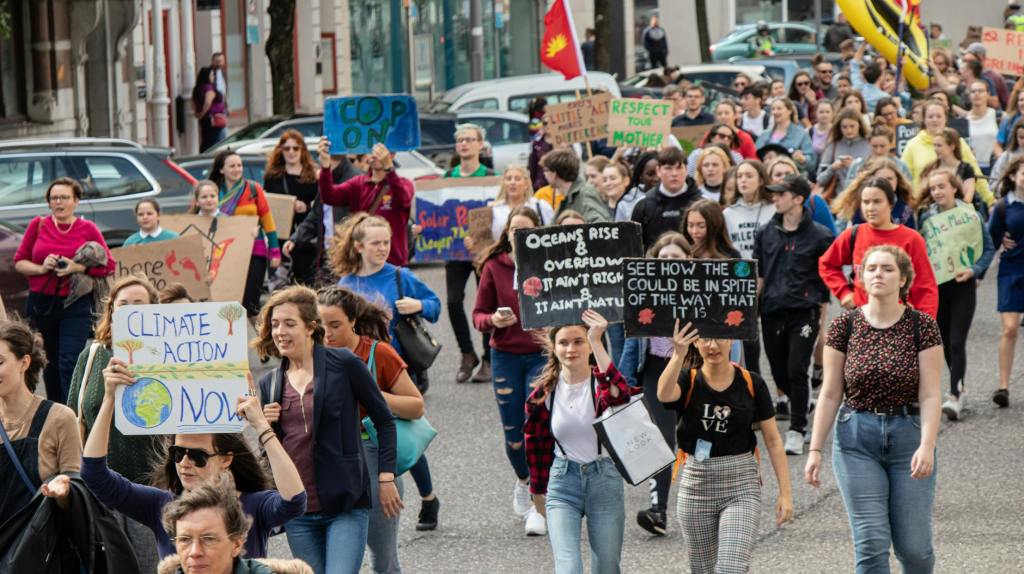
The Knowledge-Action Gap
First of all, there’s something we need to learn from climate change deniers.
Climate deniers are congruent, they don’t believe in Climate Change and they act accordingly. But I know a lot of people who do believe in Climate Change and mostly act as if nothing’s going to happen (me included). See David Finnigan unpacking this contradiction at the TED stage. In a nutshell, climate change believers go about our lives doing very small things that ease our minds but don’t really make a big impact.
Pew Research Center reports about the Knowledge-Action Gap showing that 64% of people support the idea of sustainable behavior, yet only 26% of them actually engage in sustainable action. Furthermore, as read in The Carbon Almanac: “People tend to underestimate the most impactful climate actions, like voting for leaders who are prepared to fight the climate problem, while overestimating less impactful ones like recycling and replacing lightbulbs.”
Act as if you truly believe it
If you really want to live like you believe in Climate Change, I encourage you (and myself!) to do things that really matter. Here’s my recommended ranking of action:
- Enormous impact
- Join the ranks of people working on Sustainability full time. Invest your full time and energy, we need it now!
- Large impact
- Civic and social action. If you’re not ready to change your full time job, actively join a climate cause and invest a share of your time, energy and network connections. For example, join climate initiatives aimed at families, get ten friends to support a climate cause with you, or campaign for political candidates who support climate change initiatives.
- Medium impact, but still super important!
- Vote with your wallet every day, in every decision you make. Here are the most impactful things you can do:
- Make the switch to an electric vehicle today!
- Stop eating beef now!
- Refrain from using any kind of single-use plastic, now!
- Buy used/refurbished stuff whenever possible, and really push yourself here!
- Stop buying new technology just because there’s a new version available. Fight planned obsolescence!
- Stop going on vacations to places you need to fly to.
- Make a conscious decision on which bank you choose to put your money in.
- Small impact, but by all means, keep it up:
- Save paper, recycle, install LED bulbs replacing incandescent ones, shop with reusable bags, etc.
See Ayana Elizabeth Johnson going into more details on the TED stage:
- Enormous impact
-
Unequivocal Evidence

As reported by Columbia University Climate School, the favored refrain of climate deniers and those who oppose climate policies is that “the science is not settled.” To some degree, this is true. Climate scientists are still uncertain about a number of phenomena. But it is the nature of science to never be settled — science is always a work in progress, constantly refining its ideas as new information arrives.
Certain evidence, however, is clear: global temperatures are rising, and humans are playing a role in it. And just because scientists are uncertain about some other areas, does not negate what they are sure about.
An established fact
The Intergovernmental Panel on Climate Change (IPCC), is the United Nations body for assessing the science related to climate change. The IPCC is an organization of governments that are members of the United Nations or the World Meteorological Organization, it currently has 195 members. Thousands of people from all over the world contribute to the work of the IPCC.
“Since systematic scientific assessments began in the 1970s, the influence of human activity on the warming of the climate system has evolved from theory to established fact.”
IPCCThe rate of change since the mid-20th century is unprecedented over millennia.
According to NASA, the current warming trend is different because it is clearly the result of human activities since the mid-1800s, and is proceeding at a rate not seen over many recent millennia. While Earth’s climate has changed throughout its history, the current warming is happening at a rate not seen in the past 10,000 years.
It is undeniable that human activities have produced the atmospheric gases that have trapped more of the Sun’s energy in the Earth system.
Carbon dioxide in the atmosphere warms the planet, causing climate change. Human activities have raised the atmosphere’s carbon dioxide content by 50% in less than 200 years. The level of CO₂ is now higher than at any time in the past 800,000 years.

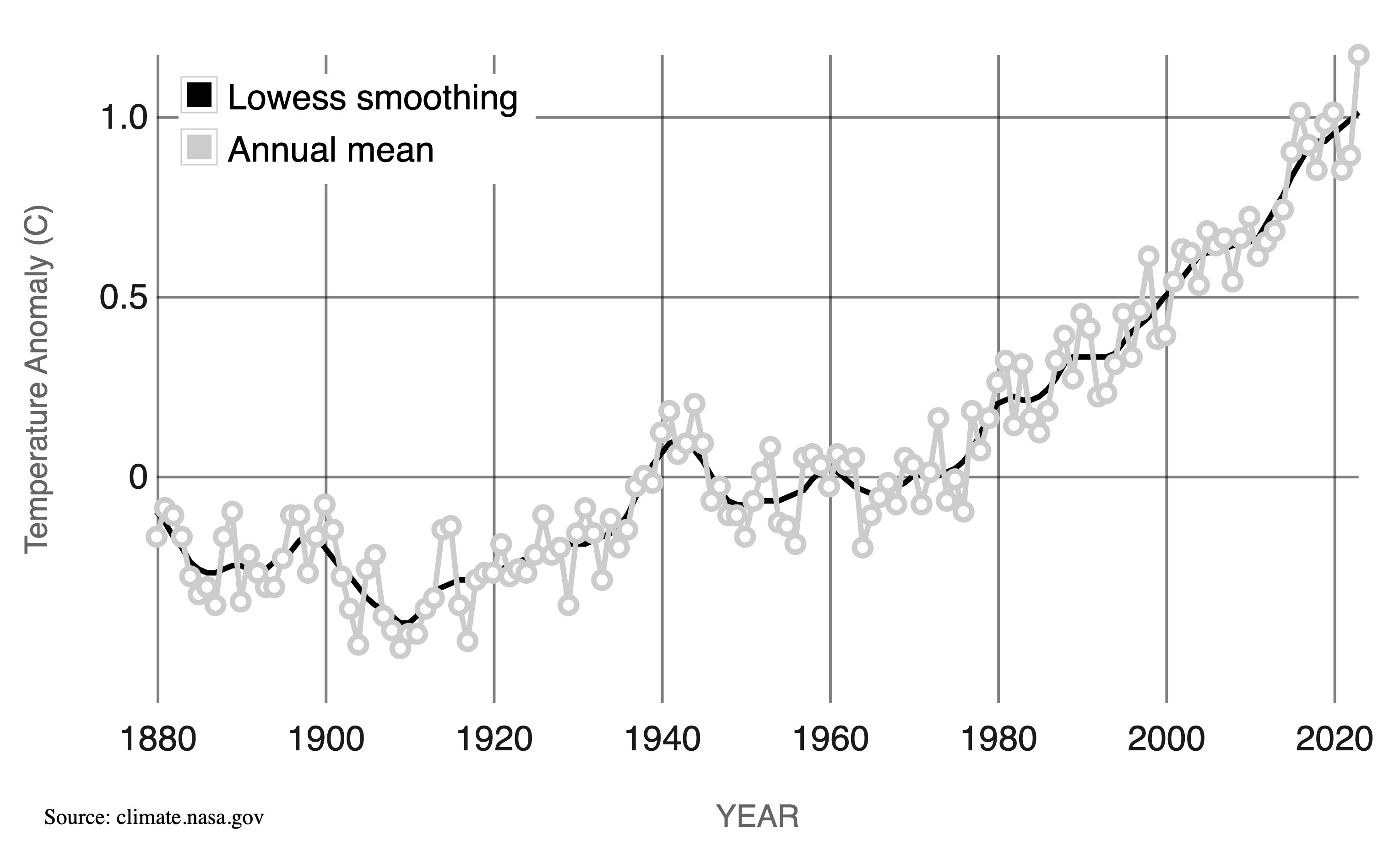
NASA (last accesses Oct 30, 2024) The 10 most recent years are the warmest years on record.
NASA’s analysis generally matches independent analyses prepared by the National Oceanic and Atmospheric Administration (NOAA) and other research groups. Overall, Earth was about 1.36 degrees Celsius warmer in 2023 than in the late 19th-century (1850-1900) preindustrial average.

NASA (last accesses Oct 30, 2024) There is unequivocal evidence that Earth is warming at an unprecedented rate. Human activity is the principal cause.
NASA (last accesses Oct 30, 2024)In the face of uncertainty
The report from Columbia University Climate School also concludes: The uncertainties in climate science that remain are not a justification for not acting to slow climate change, because uncertainty can work both ways: Climate change could prove to be less severe than current projections, but it could also be much worse.
Lastly, here are a couple of great resources to keep track of progress, or lack thereof.
- The Global Carbon Atlas: Explore and visualize the most up-to-date data on carbon fluxes resulting from human activities and natural processes. With fossil fuel emissions by country and city, land usage change, budgets, carbon monitor and much more!
- Climate Action Tracker: Tracks government climate action and measures it against the globally agreed Paris Agreement aim of “holding warming well below 2°C, and pursuing efforts to limit warming to 1.5°C.”
-
The Real Cost of a Hamburger

I must admit it, I love hamburgers, but these facts make me ponder more what I eat:
- More than 20% of the global greenhouse gases emissions (13.6 gigatons per year) are a direct result of food production, 61% of that can be traced to three main factors related to meat production:
- Destruction of carbon-reducing forests and habitats to make way for pasture land
- Pasture grown with carbon-producing fertilizers
- Cattle and sheep producing large amounts of methane as a byproduct of the digestive process 💨
- Methane is one of the most potent greenhouse gases (80 times stronger than CO2)
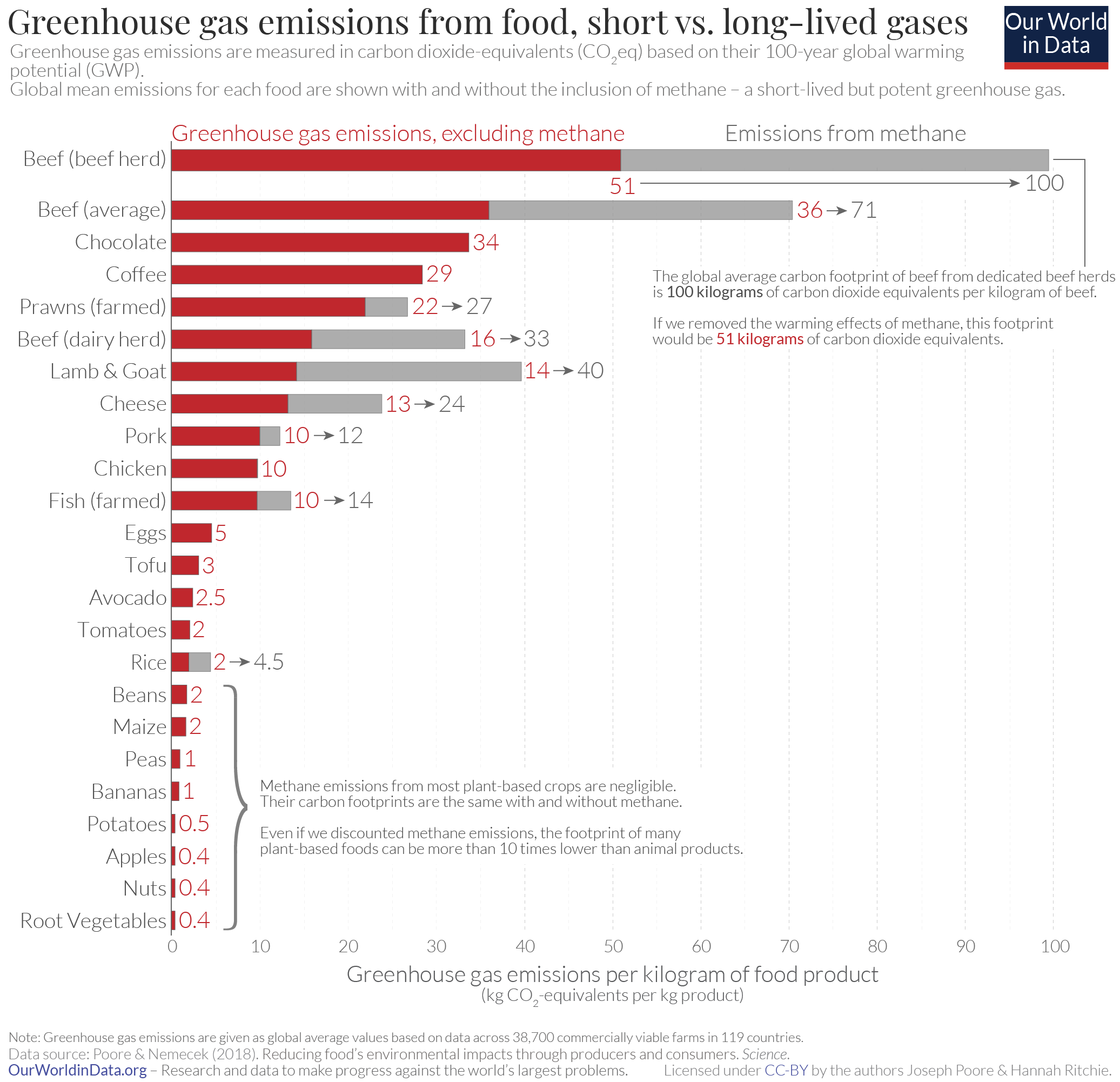
- Beef production generates 30 pounds of CO2 for every pound of meat
See this food carbon footprint comparison chart from OurWorldInData.org:

A single cheeseburger has the same climate impact as driving a typical car more than 20km/10 miles
Check all this data in:
The Carbon AlmanacAnd check out more details about our food system in this video by Pique Action:
- More than 20% of the global greenhouse gases emissions (13.6 gigatons per year) are a direct result of food production, 61% of that can be traced to three main factors related to meat production:

Tag Cloud
business climate change fun great speakers leadership management marketing okrs online marketing optimization presentation tips quotes seo social media start ups sustainability testing web analytics
Archive
- November 2024
- October 2024
- August 2024
- December 2023
- November 2023
- October 2023
- February 2023
- August 2022
- April 2022
- February 2015
- February 2013
- January 2013
- October 2012
- July 2012
- April 2012
- January 2012
- December 2011
- November 2011
- October 2011
- September 2011
- August 2011
- July 2011
- June 2011
- May 2011
- April 2011
- March 2011
- February 2011
- January 2011
- December 2010
- October 2010
- August 2010
- April 2010
- February 2010
- January 2010
- December 2009
- November 2009
- October 2009

