
As reported by Columbia University Climate School, the favored refrain of climate deniers and those who oppose climate policies is that “the science is not settled.” To some degree, this is true. Climate scientists are still uncertain about a number of phenomena. But it is the nature of science to never be settled — science is always a work in progress, constantly refining its ideas as new information arrives.
Certain evidence, however, is clear: global temperatures are rising, and humans are playing a role in it. And just because scientists are uncertain about some other areas, does not negate what they are sure about.
An established fact
The Intergovernmental Panel on Climate Change (IPCC), is the United Nations body for assessing the science related to climate change. The IPCC is an organization of governments that are members of the United Nations or the World Meteorological Organization, it currently has 195 members. Thousands of people from all over the world contribute to the work of the IPCC.
“Since systematic scientific assessments began in the 1970s, the influence of human activity on the warming of the climate system has evolved from theory to established fact.”
IPCC
The rate of change since the mid-20th century is unprecedented over millennia.
According to NASA, the current warming trend is different because it is clearly the result of human activities since the mid-1800s, and is proceeding at a rate not seen over many recent millennia. While Earth’s climate has changed throughout its history, the current warming is happening at a rate not seen in the past 10,000 years.
It is undeniable that human activities have produced the atmospheric gases that have trapped more of the Sun’s energy in the Earth system.
Carbon dioxide in the atmosphere warms the planet, causing climate change. Human activities have raised the atmosphere’s carbon dioxide content by 50% in less than 200 years. The level of CO₂ is now higher than at any time in the past 800,000 years.

The 10 most recent years are the warmest years on record.
NASA’s analysis generally matches independent analyses prepared by the National Oceanic and Atmospheric Administration (NOAA) and other research groups. Overall, Earth was about 1.36 degrees Celsius warmer in 2023 than in the late 19th-century (1850-1900) preindustrial average.
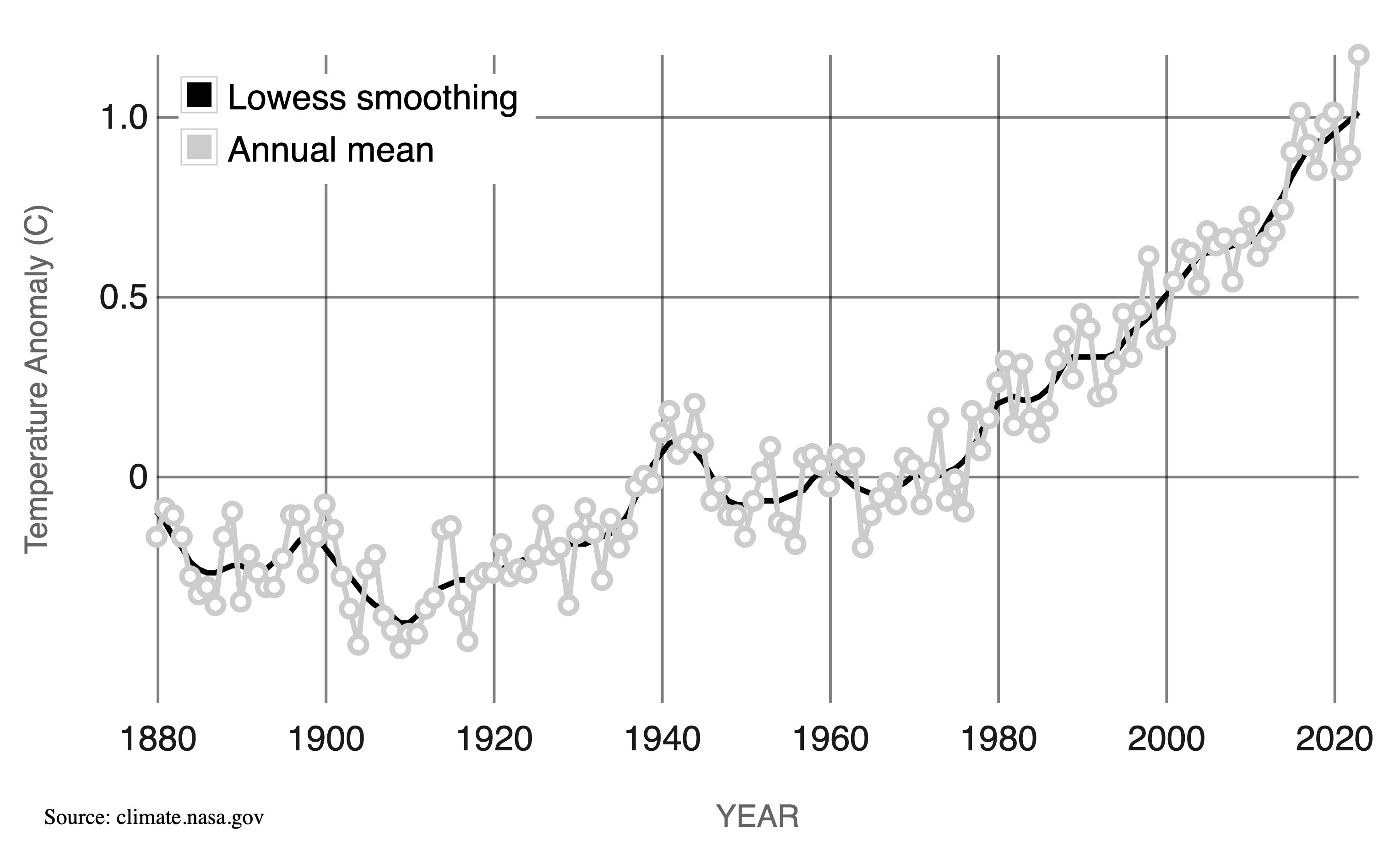
There is unequivocal evidence that Earth is warming at an unprecedented rate. Human activity is the principal cause.
NASA (last accesses Oct 30, 2024)
In the face of uncertainty
The report from Columbia University Climate School also concludes: The uncertainties in climate science that remain are not a justification for not acting to slow climate change, because uncertainty can work both ways: Climate change could prove to be less severe than current projections, but it could also be much worse.
Lastly, here are a couple of great resources to keep track of progress, or lack thereof.
- The Global Carbon Atlas: Explore and visualize the most up-to-date data on carbon fluxes resulting from human activities and natural processes. With fossil fuel emissions by country and city, land usage change, budgets, carbon monitor and much more!
- Climate Action Tracker: Tracks government climate action and measures it against the globally agreed Paris Agreement aim of “holding warming well below 2°C, and pursuing efforts to limit warming to 1.5°C.”
 Enrique Quevedo
Leave a comment